Noirvember · Anniversary feature
Gilda at 80
I knew the hair flip long before I knew the movie. Eighty years on, it’s the quieter moments that keep me coming back.

The first time I saw Gilda was in a film. Yes, that’s right. I was watching a film where they were watching a film, and that film was Gilda. The scene was the hair flip.
I’m guessing 90 percent of you already know what film I’m talking about. If you said The Shawshank Redemption, you should be awarded a cake.
Probably one of the best films ever made to never win an Oscar. I mean, Forrest Gump was good, but Shawshank? I don’t know. It was really good. But moving on.
And there she was, Rita as Gilda, and the boys went wild. I’m not even sure when I finally watched Gilda all the way through, but when that scene came around again, core memory unlocked.
What I’d forgotten about the actual movie was how much of it belongs to Glenn Ford before Rita even walks in.
Johnny Farrell gets there first
Before there’s a hair flip, there’s a pair of loaded dice. The camera comes up out of darkness and finds Johnny Farrell crouched over a game on the Buenos Aires waterfront. Ford gives him the easy confidence of a guy who figures he can talk his way into the next room. He also gives us Johnny’s voice. For a while, we see the city and the casino the way Johnny wants us to see them.
Ballin Mundson saves him from a robbery with a blade hidden in his walking stick. George Macready makes even a favor feel like something that will come due. When Johnny gets caught cheating at Ballin’s casino, he talks his way into a job. Soon the guy who came in looking for an angle is the one watching for angles on the floor. The tuxedo fits. You can still see the guy from the dice game underneath it.
It was Ford’s return to the screen after military service, and he’d already worked with Hayworth in The Lady in Question. Here, he gives Johnny the kind of confidence you enjoy watching because you can imagine exactly how badly it might fail him.
A little of Ace Rothstein
Watching Ford settle into the casino, I thought of Robert De Niro as Ace Rothstein in Casino. Martin Scorsese talks about his appreciation for Gilda in a supplement on the Criterion edition. In a 1995 interview, he pointed to Ocean’s 11 and 5 Against the House for the look of the old casinos. Still, it’s hard to watch Johnny and Ace without seeing a resemblance. Both know how to read a room, spot an angle and make you feel like you’re getting a look at how the house really works. Marty, care to comment?
Then Gilda walks in
Ballin Mundson asks his new wife if she’s decent. Hayworth comes up into the frame in a sweep of hair and answers, “Me?” It’s funny before it’s glamorous. Then she sees Johnny Farrell, and the smile has a different job to do. She has to greet a man she already knows while her husband watches. Look at how quickly Hayworth makes that calculation without giving up the smile.
Sheila O’Malley points out how neatly the two entrances rhyme. Johnny comes up out of the dark at the dice game. Gilda rises into a brightly lit frame. By then, Ford has spent the opening looking like the man who knows everybody’s angle. Now watch him try to get through an introduction to a woman he already knows. The smile on her face is doing more work than anything he can think to say.

Ballin can make a polite question feel like he’s taking inventory of everything in the room that belongs to him.
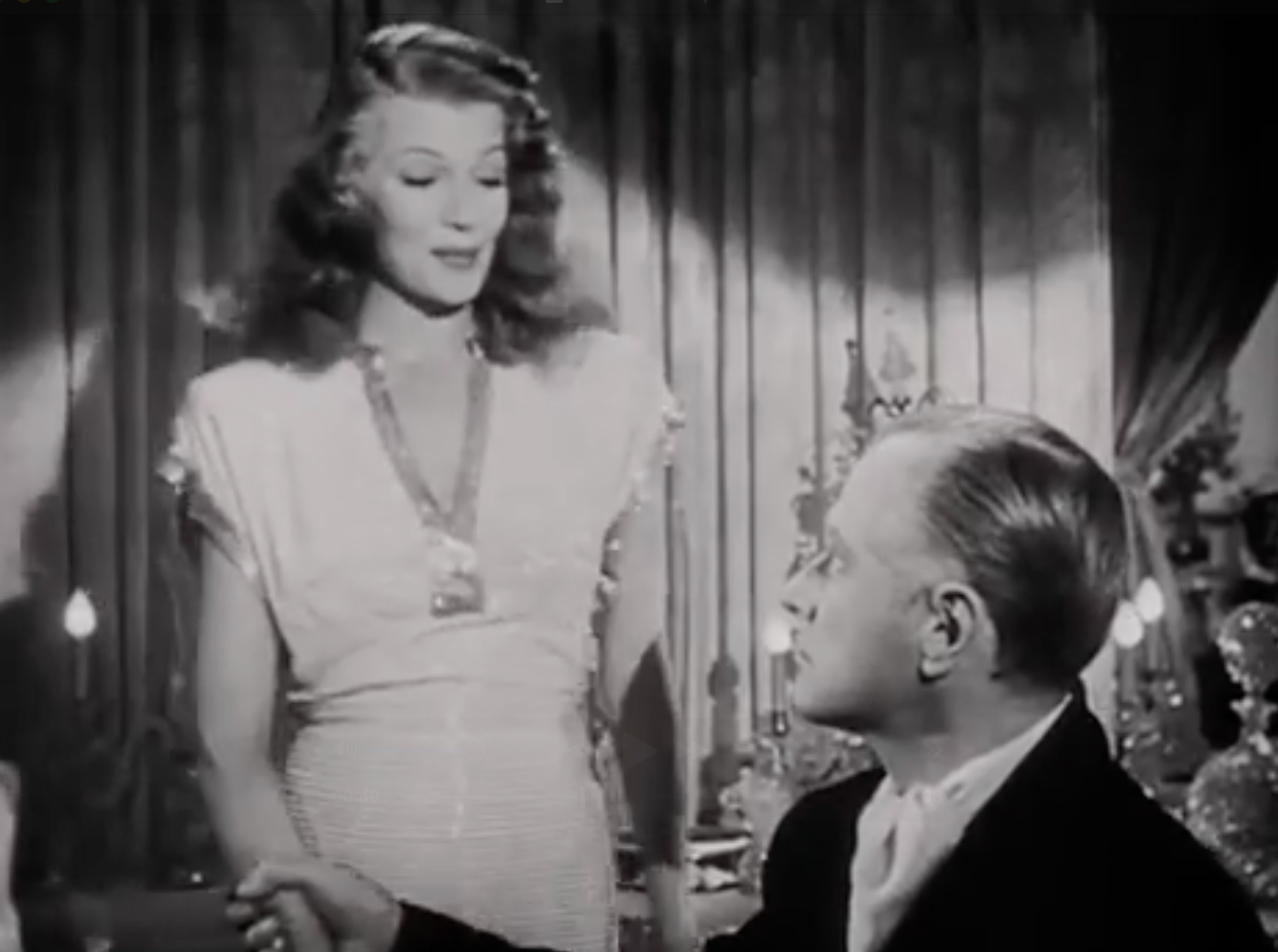
Uncle Pio, played by Steven Geray, sees the trouble early. Everybody else has money, a title or an entrance. Pio gets a washroom and a better read on the room than any of them.

The same song, two rooms
The first time Gilda sings “Put the Blame on Mame,” she has a guitar and an audience of one. Later she has a black gown, an orchestra and a room full of men. The second version is the one you’re likely to know. The first is the one that makes it hurt.
Hayworth sings it herself, according to AFI’s production notes. Anita Ellis dubbed most of her singing, including the celebrated nightclub rendition.
The joke in the song is that a woman can be blamed for just about anything. Gilda has spent much of the movie finding out how that works. By the time she sings it in front of the casino crowd, she knows exactly what they expect from her. She gives it to them, right up to the point where the men in charge wish she would stop.
Jean Louis’s black gown and long gloves give Hayworth something to work with. The Library of Congress credits Jack Cole as the uncredited choreographer. Hayworth can make an entire room wait while she takes off one glove. Then she asks for help with the dress. Watch the men when she does. They’ve been enjoying the show, and suddenly someone has to decide what kind of show they’ve been watching.

Before she was Gilda
Rita Hayworth was born Margarita Carmen Cansino in Brooklyn in 1918. Her father was a Spanish dancer and her mother had performed with the Ziegfeld Follies. The family moved to California when she was a child. By twelve she was dancing professionally with her father, including in nightclubs in Tijuana.
She started in movies as Rita Cansino. On her way to stardom at Columbia, her hairline was altered with electrolysis, her hair was dyed and she took her mother’s family name. The studio could change the name and the look. The timing she brought to the screen came from years onstage.
For a quick tour of what she could do, watch her with Fred Astaire in You Were Never Lovelier (1942), then with Gene Kelly in Cover Girl (1944). After Gilda, try The Lady from Shanghai (1947), where Orson Welles casts her as a blonde and puts her in a hall of mirrors. Those are four very different ways of watching the same performer.
Hayworth was already a star, with Astaire and Kelly pictures behind her. Gilda gave that stardom a character people would keep confusing with the woman herself. AFI calls it her first major dramatic role for Columbia and a turning point that fixed her image as a femme fatale.
Buenos Aires, by way of Hollywood
For all its South American intrigue, Gilda is a Hollywood studio creation. Columbia built its Buenos Aires world in Los Angeles, with art direction by Stephen Goosson and Van Nest Polglase and set decoration by Robert Priestley. The casino, the private rooms, the polished surfaces that catch Maté’s light. This is a city designed around the people who are trapped in it.
The casino gives cinematographer Rudolph Maté two worlds to light. On the floor, everyone can see everyone else. In the back rooms, the same immaculate clothes look a little sinister. The men move between those worlds as if they own both. Gilda has the stage, and Hayworth makes you feel exactly how much and how little that buys her.
AFI cites a 1945 report that the story was originally set in the United States. Objections from the Breen Office sent it to Buenos Aires. That gives the film its casino setting and its particular mix of gambling, wartime money and men who keep their business vague.
There was a whole art to making these worlds. A studio let filmmakers place the wall, the window and the shadow exactly where the scene needed them. European émigrés such as Fritz Lang brought experience with expressionist filmmaking to Hollywood. By the later 1940s, films such as The Naked City were taking noir onto real city streets, but the carefully built nightmare had a life of its own.
More worlds built for trouble
Gilda had plenty of company. Think of the studio craft behind these noir favorites, from entire cities built on lots to a Florida storm conjured in Burbank.
- The Maltese Falcon (1941). Warner Bros. gave Bogart a San Francisco made largely within the studio.
- Phantom Lady (1944). Universal’s sets became a shadowy New York of bars, sidewalks and subway platforms.
- Scarlet Street (1945). Fritz Lang built his Greenwich Village nightmare entirely on California soundstages.
- Detour (1945). PRC soundstages did much of the work, alongside location filming, in Ulmer’s cross-country bad dream.
- The Big Sleep (1946). Hawks and company created Chandler’s Los Angeles on the Warner Bros. lot.
- Key Largo (1948). Apart from its opening shots, Huston’s Florida thriller was filmed at Warner Bros., with a studio tank standing in for the sea.
Hollywood in the studio era
In the 1940s, Los Angeles was the center of the American studio system. The major studios had soundstages, backlots and workshops where crews could build a San Francisco office, a New York street or a Buenos Aires casino. Today, with productions spread across more cities and countries, Los Angeles is working to keep more filming here.
Part of the romance of classic Hollywood is that all those faraway places came to life right here. Gilda takes us to Buenos Aires, but the casino, the shadows and that entrance were made in Los Angeles. I’d like to see more movies made here again. This city helped give the movies their language, and it should still be a place where filmmakers get to add to it.
Eighty years, and still getting booked
Opening night at Radio City
The New York opening was at Radio City Music Hall on March 14, 1946. Think about that for a moment. The little hair flip that many of us first saw on a television in Shawshank once filled the screen at one of New York’s grandest movie palaces. AFI dates the wider American release to April 25. The anniversary belongs to a real theatrical event, with an audience that had no idea what was about to become famous.
From nitrate to 4K
In 2024, Cannes Classics presented Gilda as part of its celebration of Columbia Pictures’ hundredth anniversary. Sony’s restoration drew on the original 35mm nitrate negative and a nitrate internegative, with 4K image work and restored sound from the original nitrate soundtrack negative. Grover Crisp supervised the restoration.
That is a good reason to see it in a theater again, even if you know the story. Look at the sheen of the gown, the detail in the casino and the way Maté separates faces from darkness. All that careful work deserves a screen big enough to notice it.
Still on the screen
The restored Gilda screened at the Academy Museum in Los Angeles after Cannes. MoMA included the film in its Columbia retrospective in 2025, and AFI Silver marked its eightieth anniversary in 2026.
There are a couple of lasting honors, too. Gilda entered the National Film Registry in 2013, and “Put the Blame on Mame” placed No. 84 on AFI’s 2004 list of the hundred greatest American movie songs. The hair gets the entrance. The song gets its own place in history.
Watch the trailer
Before the next screening
Next time, watch Ford before the hair flip. See how long it takes him to make you think he owns the room. Then watch what Hayworth does with it, first with that smile and later with a guitar.
Red knew when to look up. I just wish he’d told me to stick around for the guitar.
Sources and image credits
- FilmLA on incentives to keep production local
- Ballin and Gilda image: trailer frame supplied by Bob Warner.
- Scorsese on the films he consulted for the look of Casino
- American Cinematographer interview on Casino and its narration
- TCM clips of Johnny’s opening and Gilda’s entrance
- Martin Scorsese on California and The Maltese Falcon’s studio-created San Francisco
- The Big Sleep: Warner Bros. filming
- TCM: Key Largo’s studio work, opening shots and tank scenes
- Robert Polito: Detour’s documented soundstage and location filming
- Roy Stafford on Phantom Lady’s Universal studio settings
- FilmLA research on Los Angeles production
- International Dictionary of Films and Filmmakers: Gilda’s design credits and casino sets
- Gilda: listed Hollywood filming location
- BFI: Scarlet Street’s soundstages and the move to location filming
- BFI: noir’s European influences and studio and location styles
- AFI: The Woman in the Window’s studio work and New York background footage
- International Dictionary of Films and Filmmakers: Laura’s filming at Fox
- TCM on the Radio City opening
- Cannes Classics 2024: Columbia centenary and Sony restoration credits
- Academy Museum: June 2024 restoration screening
- MoMA: May 2025 screenings
- AFI Silver: 2026 anniversary presentation
- Library of Congress: 2013 National Film Registry selection
- AFI Catalog production history and singing credits
- Criterion credits and Scorsese and Luhrmann supplement
- Sheila O’Malley on Hayworth’s performance
- Stephen King’s original novella
- Library of Congress essay on Hayworth and Gilda
- American National Biography on Hayworth’s early years
- National Film Registry personnel credits
- Both Columbia Pictures trailer frames are listed as public domain in the United States on their linked Commons file pages.